

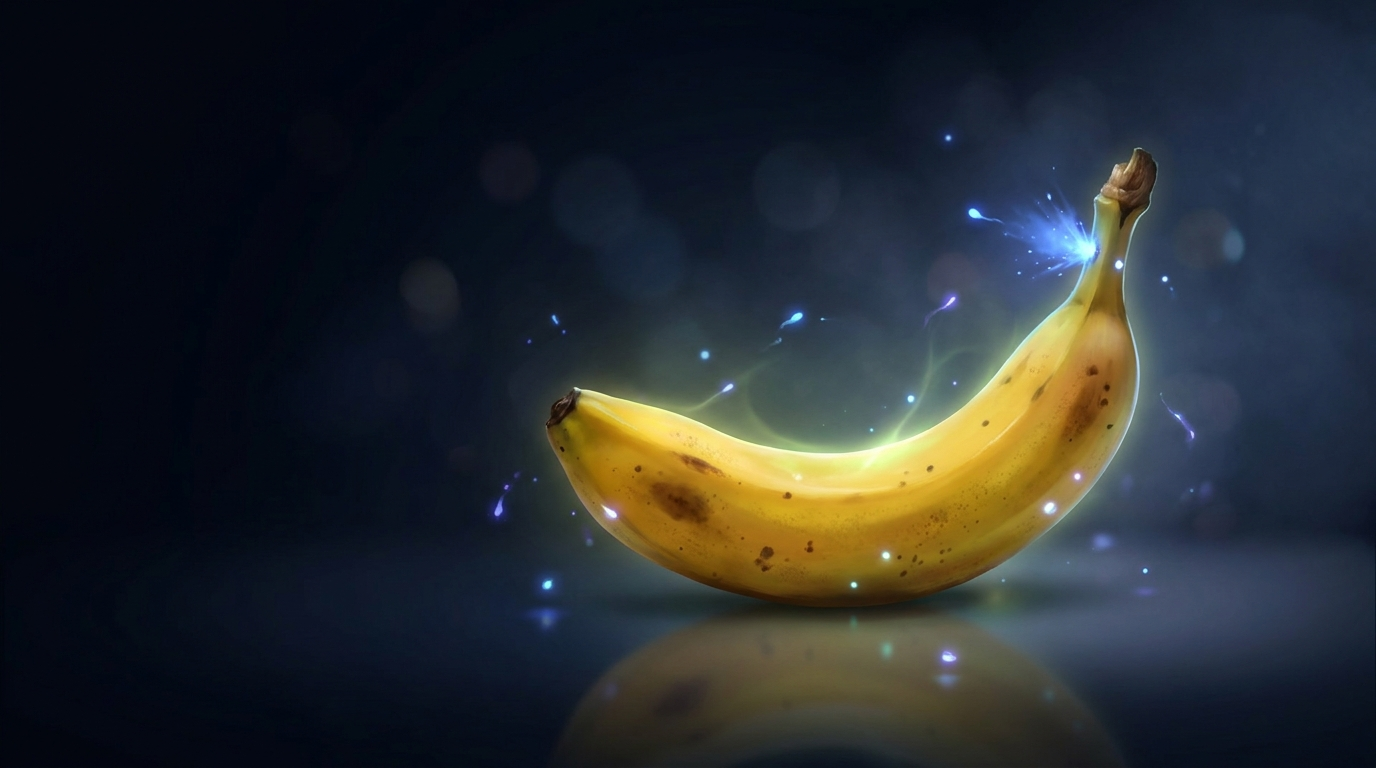
Here’s a fact that sounds like a prank but isn’t: the bananas sitting in your kitchen right now are slightly radioactive. The reason is potassium. Bananas are famously rich in it, and potassium is essential — your muscles and nerves literally can’t fire without it. But not every potassium atom is the ordinary, stable kind. About one in every 8,500 is potassium-40, a naturally unstable isotope left over from the formation of the Earth. Its nucleus is quietly, randomly falling apart, and every time one does, it releases a tiny burst of radiation. Multiply that by the billions of potassium atoms in a single banana, and your afternoon snack becomes a very gentle, very real source of radioactivity.
Before you swear off smoothies, here’s the reassuring part. The dose is astonishingly small — so small that physicists jokingly use the “banana equivalent dose” as a casual way to talk about trace radiation exposure. Eating one banana gives you roughly the same dose you’d get from a few minutes of ordinary background radiation, and your body doesn’t let it build up: potassium levels are tightly regulated, so any excess is simply flushed away long before it could matter. You would have to eat millions of bananas in one sitting to approach a dangerous dose — a feat with far bigger problems than radiation. So the takeaway is delightfully undramatic: bananas are radioactive, radioactivity is everywhere in trace amounts, and both are perfectly safe. Nature is just weirder and more wonderful than it lets on.