

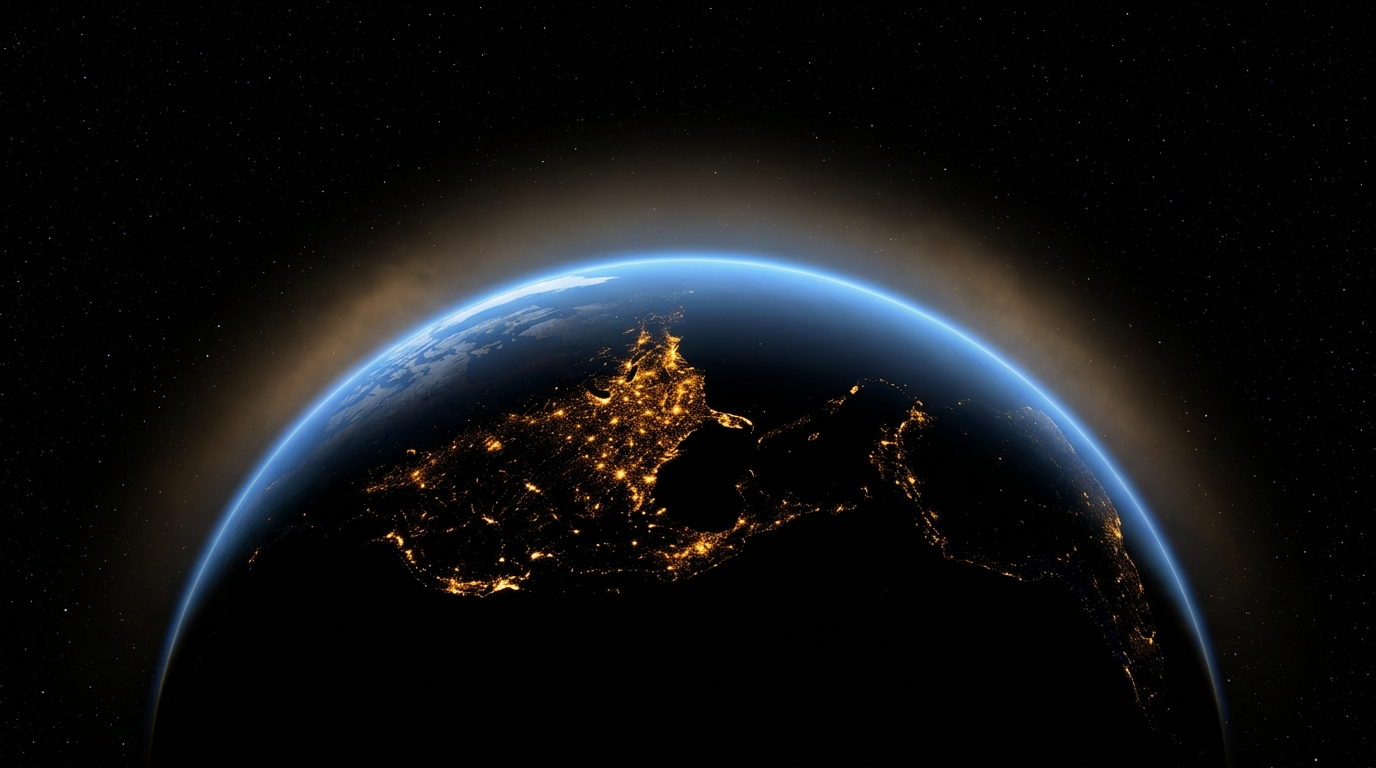
Every night, the Sun disappears for hours—yet Earth’s temperature typically drops only 10 to 15 degrees, not hundreds. Compare that to the Moon, which sits at the same distance from the Sun: its nighttime surface plunges to about −130°C. The difference is our atmosphere, and specifically a handful of gases in it—water vapor, carbon dioxide, and methane—that perform a remarkable trick. During the day, sunlight passes through the atmosphere almost untouched and warms the ground. The warmed Earth then radiates that energy back toward space, but not as visible light—as invisible infrared radiation. And this is where greenhouse gases go to work: their molecules are precisely the right shape to absorb infrared radiation, catching the outgoing heat before it can escape to space.
Once a greenhouse gas molecule absorbs infrared energy, it re-emits it in a random direction—and roughly half of that energy heads back down toward the surface. The result is a continuous recycling of heat between the ground and the sky, like a blanket that doesn’t generate warmth but slows its escape. This natural greenhouse effect keeps Earth’s average temperature around a comfortable 15°C; without it, our planet would average about −18°C, and nights would be brutally cold. So the greenhouse effect itself isn’t the villain it’s often made out to be—it’s the reason liquid water, and life, can exist here at all. The modern problem is one of degree: by adding extra CO₂, we’re thickening a blanket that was already perfectly tuned.