

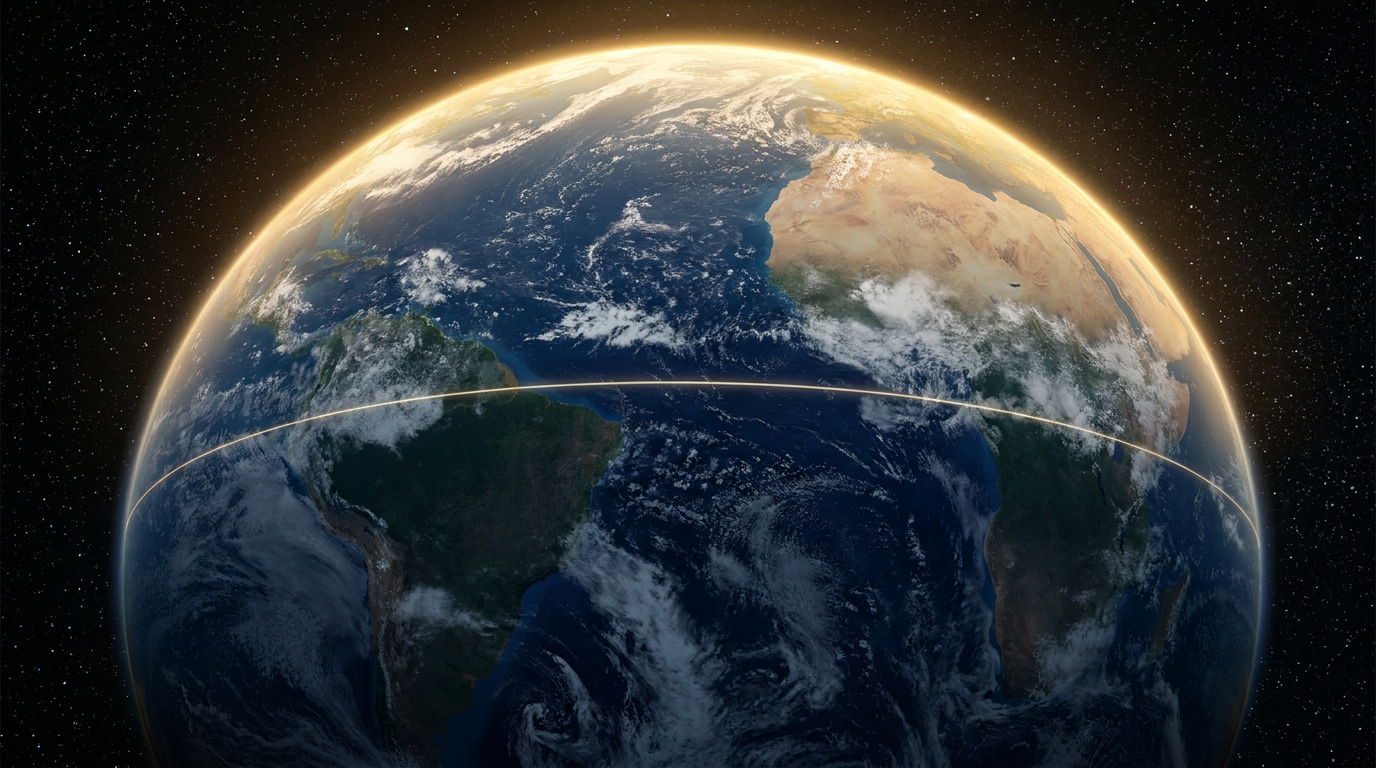
Imagine stepping onto the same bathroom scale twice on the same day, once near the North Pole and once at the equator, and watching the number shrink. It sounds like a trick, but it is real physics. You would weigh slightly less at the equator than at the poles, even though you are the exact same person who ate the exact same breakfast. The culprit is not your diet or your scale. It is the planet beneath your feet behaving in ways most of us never notice.
Two effects work together to lighten you up. First, Earth spins, and it spins fastest at the equator, where the surface is racing around at over 1,000 miles per hour. That rotation flings you gently outward, pushing against the gravity that holds you down, much like the way you feel pressed outward on a fast merry-go-round. Second, our planet is not a perfect sphere. All that spinning has caused Earth to bulge at its middle, so a person standing at the equator sits farther from the center of the planet than someone at the poles. Since gravity weakens with distance, that extra stretch means a slightly gentler pull.
Add the two effects together and the difference comes out to about half a percent. That does not sound like much, but for a 220 pound person it means shedding nearly a full pound just by changing latitude, no gym required. Here is the beautiful catch: your mass, the actual amount of stuff that makes up you, never changes at all. Only your weight does, because weight is simply gravity’s grip on that mass. So the equator is not really a weight-loss machine. It is a reminder that the ground under us is spinning, bulging, and quietly bending the rules we take for granted every single day.