

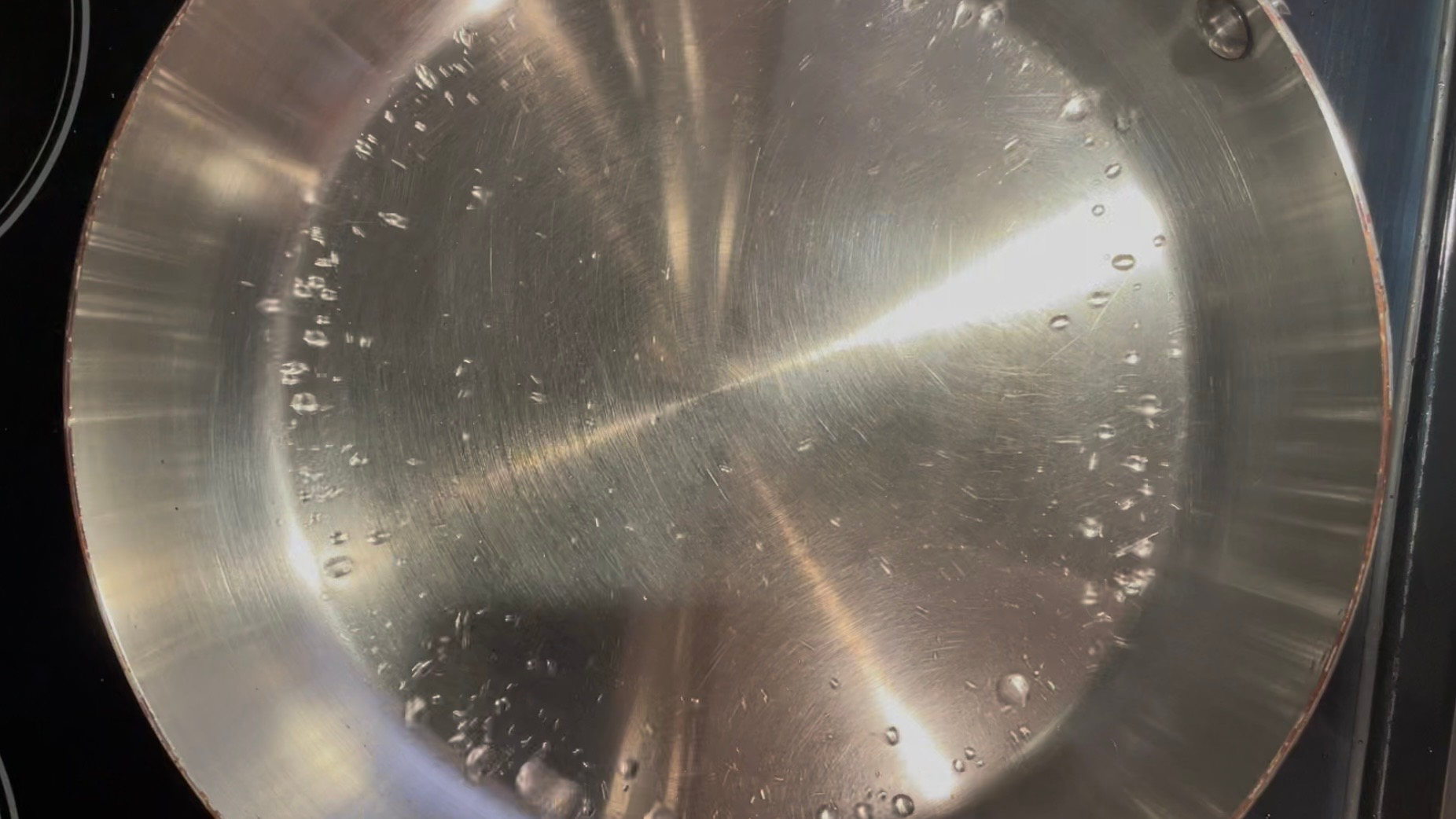
It sounds backwards: turn a pan hotter, and a drop of water survives longer instead of vanishing faster. Splash a few drops onto a warm skillet and they hiss, spread, and boil away in a second or two. But heat that same pan past roughly 193°C (380°F) and something strange happens. The droplets pull themselves into tight little beads and skate across the surface, gliding around as if the hot metal were a sheet of ice. This is the Leidenfrost effect, named for the German doctor who described it back in 1756.
The trick is a cushion of vapor. When the droplet meets a surface that hot, the underside flashes into steam the instant it touches down. That thin layer of gas, only about a tenth of a millimeter thick, is a poor conductor of heat, so it acts like insulation between the water and the pan. The vapor also pushes up on the droplet, lifting it just off the surface. Now the drop is riding on its own steam, shielded from the very heat that created it, and with almost nothing to slow it down it slides around nearly friction-free.
That insulation is why the counterintuitive part holds up: a droplet on a merely hot pan boils away in seconds, but a droplet floating on its vapor layer can last for minutes. Scientists see the same physics well beyond the kitchen, from cooling systems in industrial equipment to the way liquid nitrogen scatters across a floor. So the next time you see water dance across a scorching skillet, you are watching a droplet levitate on a blanket of its own steam.