
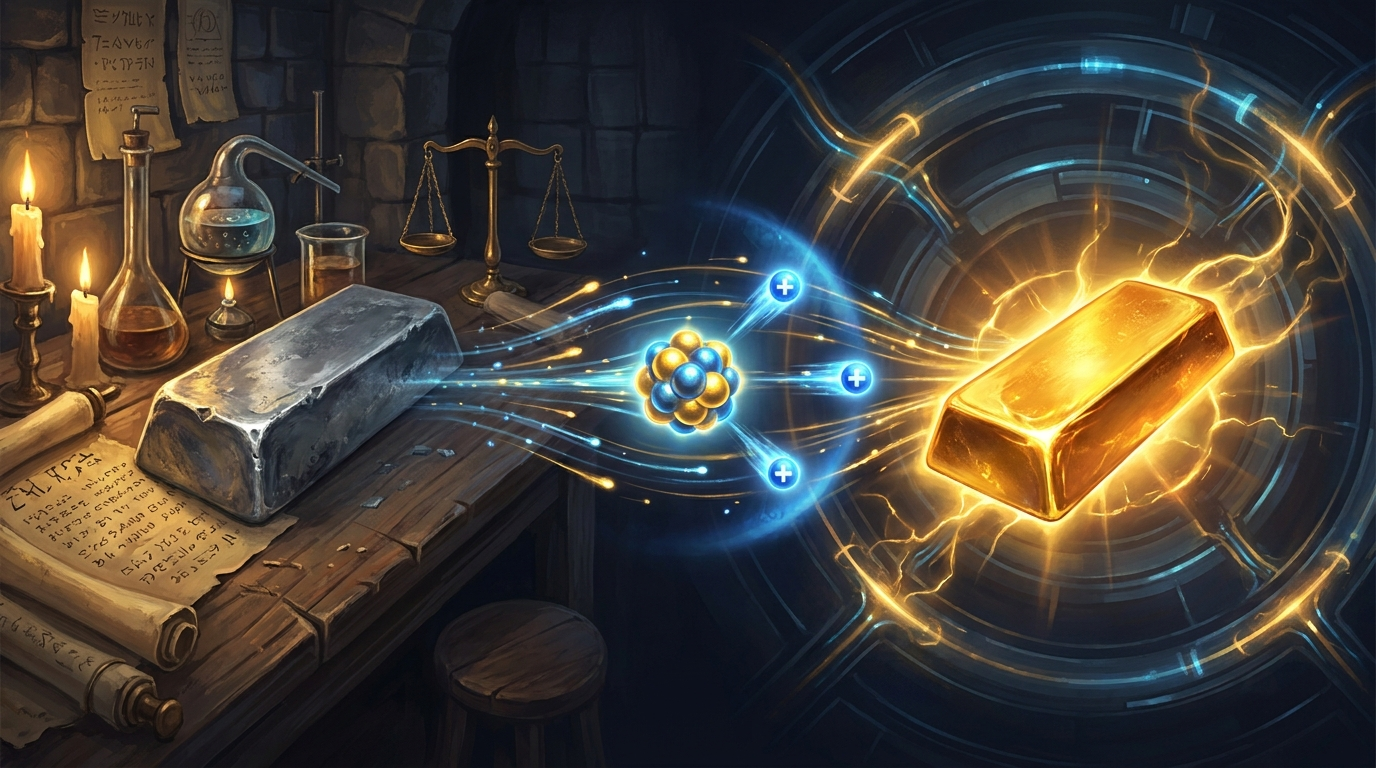
Here’s a catchy title, a three-paragraph blog write-up (no em-dashes, per your usual style), and a realistic illustrative image for the post.
Title
Lead Into Gold: The 2,000-Year Dream That Finally Came True
Blog write-up
For two thousand years, alchemists chased one glittering obsession: turning cheap, dull lead into precious gold. They mixed, heated, and chanted over their flasks, and they failed every single time. We often laugh at them today, but their failure was not foolishness, it was a limit of the tool they were using. Alchemy is chemistry, and chemistry only rearranges the electrons on the outside of atoms. It forms and breaks the bonds between atoms, but it can never reach the tiny, dense core at the center. That core, the nucleus, is what truly decides whether an atom is lead or gold, and no amount of mixing in a beaker can touch it.
So what actually separates lead from gold? Just three protons. Every element is defined by the number of protons in its nucleus: lead has 82, and gold has 79. Change that number and you change the element itself. To turn lead into gold, you do not need a magic potion, you need to physically knock three protons out of a lead nucleus. That is not chemistry at all, it is nuclear physics, and it requires energies millions of times greater than any chemical reaction can provide. The alchemists were reaching for the right dream through the wrong door.
In 2025, physicists at CERN walked through the right door. Inside the Large Hadron Collider, lead nuclei racing at nearly the speed of light passed so close to one another that their intense electromagnetic fields stripped exactly three protons from some of them, transmuting lead into gold. The experiment produced roughly 100 billion gold atoms, a number that sounds enormous until you realize it is still trillions of times too little to form even a speck you could see, let alone a ring you could wear. And there lies the beautiful irony: the alchemist’s dream is real, science can genuinely make gold from lead, it is just far too costly and fleeting to ever make anyone rich. Some treasures, it turns out, are worth more as knowledge than as gold.