

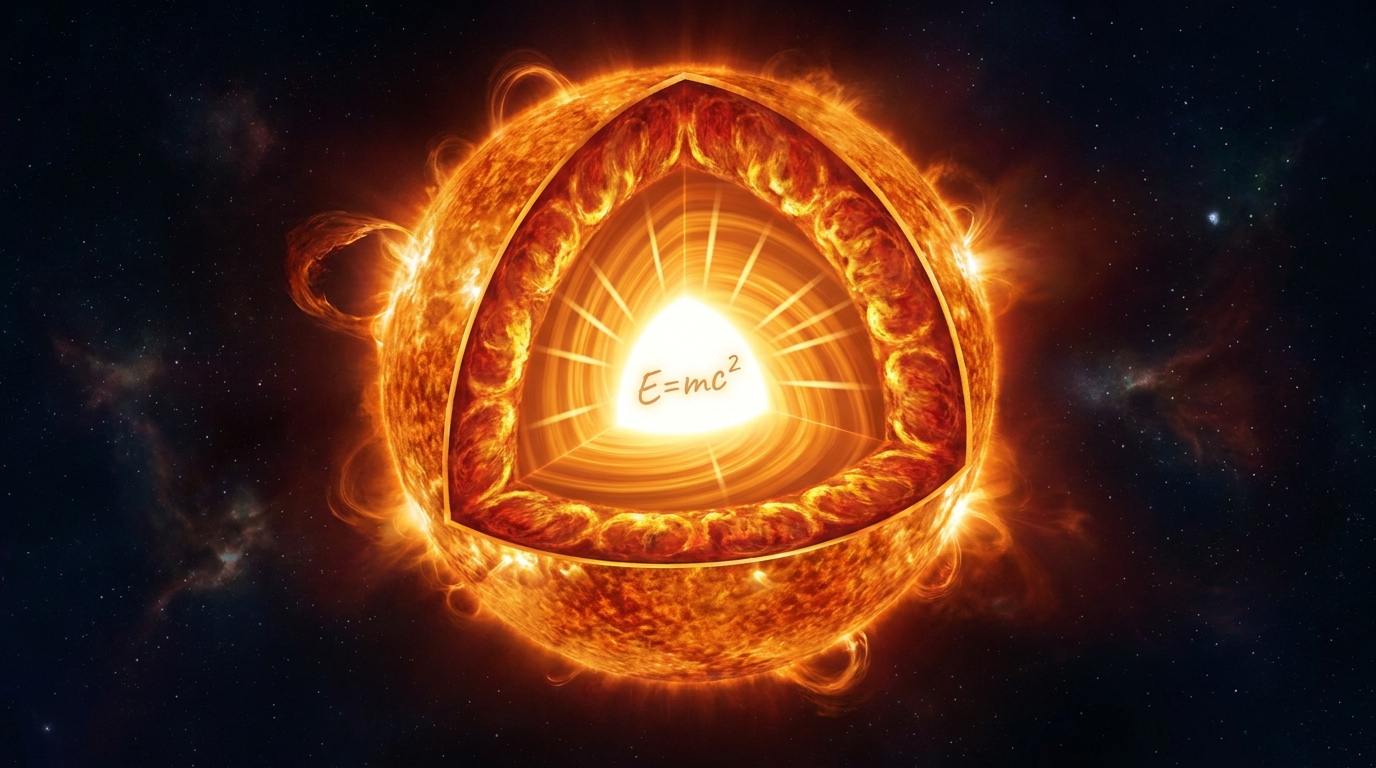
A star shines because of a delicate balance between two opposing forces: gravity, which relentlessly pulls all of the star’s mass inward, and the enormous pressure generated at its core. When a star forms from a collapsing cloud of hydrogen gas, gravity compresses the core to extreme densities and temperatures—over 15 million degrees in a star like our Sun. At these temperatures, hydrogen nuclei (protons) move so fast that they can overcome their natural electrical repulsion and slam into each other, fusing together through a chain of reactions that ultimately converts four hydrogen nuclei into one helium nucleus. Here’s the key: a helium nucleus is slightly lighter than the four protons that made it. That tiny missing mass—about 0.7%—doesn’t disappear; it transforms into pure energy according to Einstein’s famous equation, E = mc². Because c² is such an enormous number, even a tiny bit of mass yields a staggering amount of energy.
This released energy is what makes a star glow. It emerges from the core as high-energy photons and slowly works its way outward—taking tens of thousands of years to escape the Sun’s dense interior—before finally radiating into space as the light and heat we see. The energy flowing outward also creates the pressure that pushes back against gravity, holding the star up and preventing further collapse. This self-regulating equilibrium, called hydrostatic balance, is why stars are so stable: if fusion speeds up, the core expands and cools, slowing fusion back down; if fusion slows, gravity compresses the core and reignites it. A star like our Sun can maintain this balancing act for about 10 billion years, converting roughly 600 million tons of hydrogen into helium every second—shining not because it burns like a fire, but because it is slowly, steadily converting its own mass into light.