

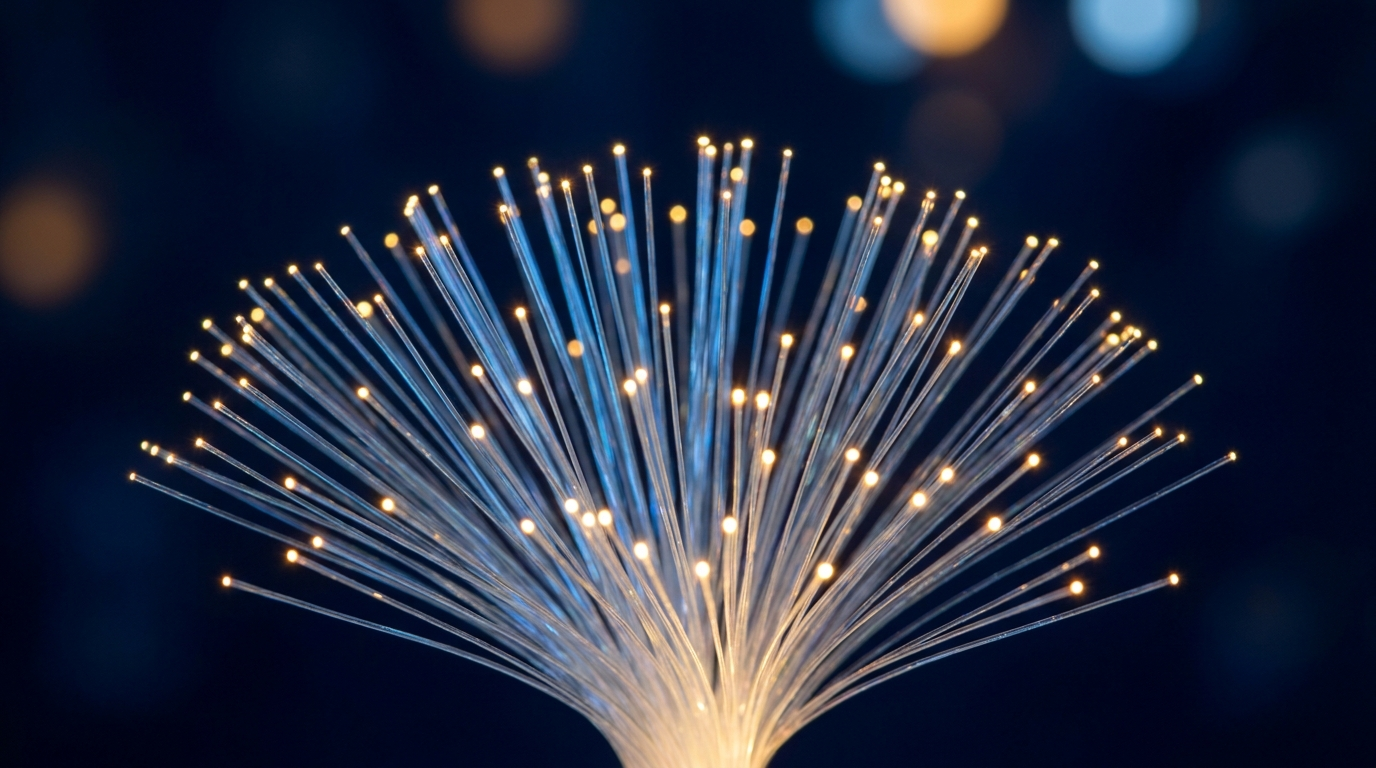
Every message you send races across the planet as pulses of light locked inside strands of glass thinner than a human hair. It sounds impossible: light is famously hard to contain, yet an optical fiber holds onto it for thousands of miles. The secret is a beautifully simple piece of physics called total internal reflection, and it all comes down to the angle at which light strikes the wall of the fiber.
When light traveling inside glass hits the boundary with the outside world, one of two things can happen. If it strikes the wall at a steep angle, it refracts, bending as it passes through, and escapes into the air. But as you lower that angle and let the light graze the wall more gently, you reach a special point called the critical angle, where the escaping beam bends so far that it skims along the surface itself. Push just past that point, and the light stops leaving altogether. Instead it reflects perfectly back inside, as if the glass wall had turned into a flawless mirror.
That single trick is what makes the modern world run. Inside an optical fiber, light enters at a shallow angle and bounces down the glass core again and again, striking the walls far below the critical angle every time, so it can never escape. It zigzags along the entire length of the cable with almost no loss, carrying your calls, videos, and data beneath oceans and across continents. The next time a page loads in an instant, remember that it arrived as a beam of light that was simply never allowed to leave its glass tunnel.