

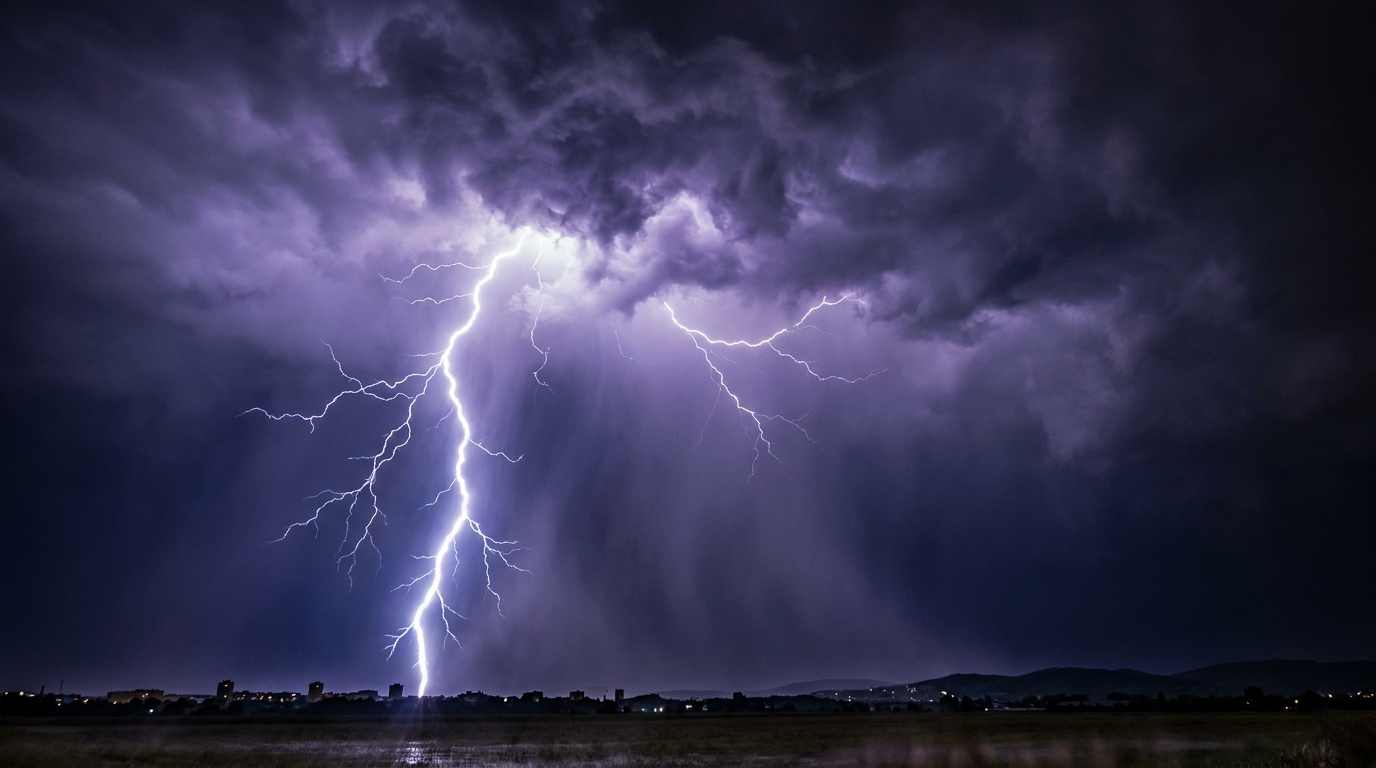
We have all watched a bolt of lightning tear across the sky and split into a jagged, branching flash. It never shoots down in a clean straight line, and there is a beautiful reason for that. It comes down to a simple fact: air is an excellent insulator. It fights hard to stop electricity from flowing through it. So when charge builds up inside a storm cloud, the pressure climbs to tens of millions of volts before the air finally gives way. And when it does give way, it does not break evenly.
Instead, a faint channel called the stepped leader begins pushing down from the cloud in short, sudden jumps of about fifty meters at a time. At every jump, it heads toward wherever the surrounding air is weakest and easiest to break through. Those weak spots (created by random pockets of moisture, dust, and stray ions) are scattered unpredictably, so the leader lurches first one way and then another, carving out a crooked path. Where several weak routes open at once, the channel splits, and that is exactly why lightning branches like the limbs of a tree.
The finale happens in a fraction of a millisecond. Once the leader touches the ground, a massive surge of current, the return stroke, rushes back up the channel and lights the entire crooked path in a blinding flash. That is the lightning we actually see. So the next time a bolt zigzags across the horizon, remember what you are really looking at: electricity taking the messiest possible shortcut, one desperate jump at a time. Nature rarely moves in straight lines, and lightning is the most spectacular proof of all.