

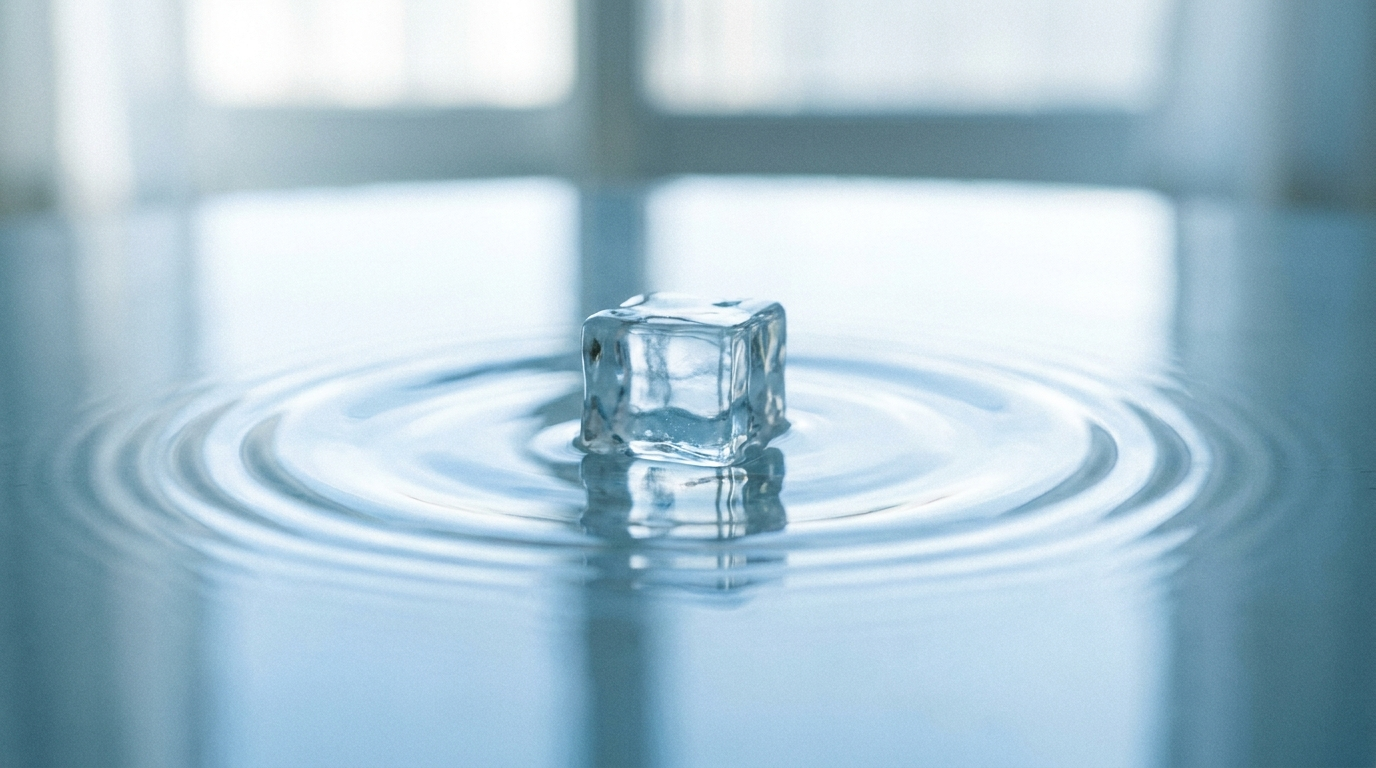
Almost every substance in nature becomes denser when it freezes—its molecules pack tighter as they slow down and lock into place. Water is the famous rebel. The secret lies in the water molecule’s bent shape and its ability to form hydrogen bonds: weak attractions between the slightly positive hydrogen atoms of one molecule and the slightly negative oxygen atom of its neighbor. In liquid water, molecules tumble around and squeeze fairly close together, constantly making and breaking these bonds. But when water freezes, the hydrogen bonds force every molecule into a rigid, open crystal structure—a repeating hexagonal lattice, the same six-sided geometry you see in snowflakes. This “hidden hexagon” is full of empty space, so ice ends up about 9% less dense than the liquid water it came from. Less dense means it floats.
That one quirk of molecular geometry quietly makes life on Earth possible. Because ice floats, lakes and oceans freeze from the top down instead of the bottom up. The floating ice layer acts as an insulating blanket, keeping the water below liquid so fish and aquatic life can survive the winter. If ice sank like almost every other frozen solid, lakes would freeze solid from the bottom, wiping out entire ecosystems every winter—and Earth’s climate history would look radically different. So the next time an ice cube bobs in your drink, remember: you’re looking at a hexagonal trick of chemistry that helped make our planet livable.